Transitioning to the Agent Decade
Reproducible Environments and Multi-Agent Orchestration
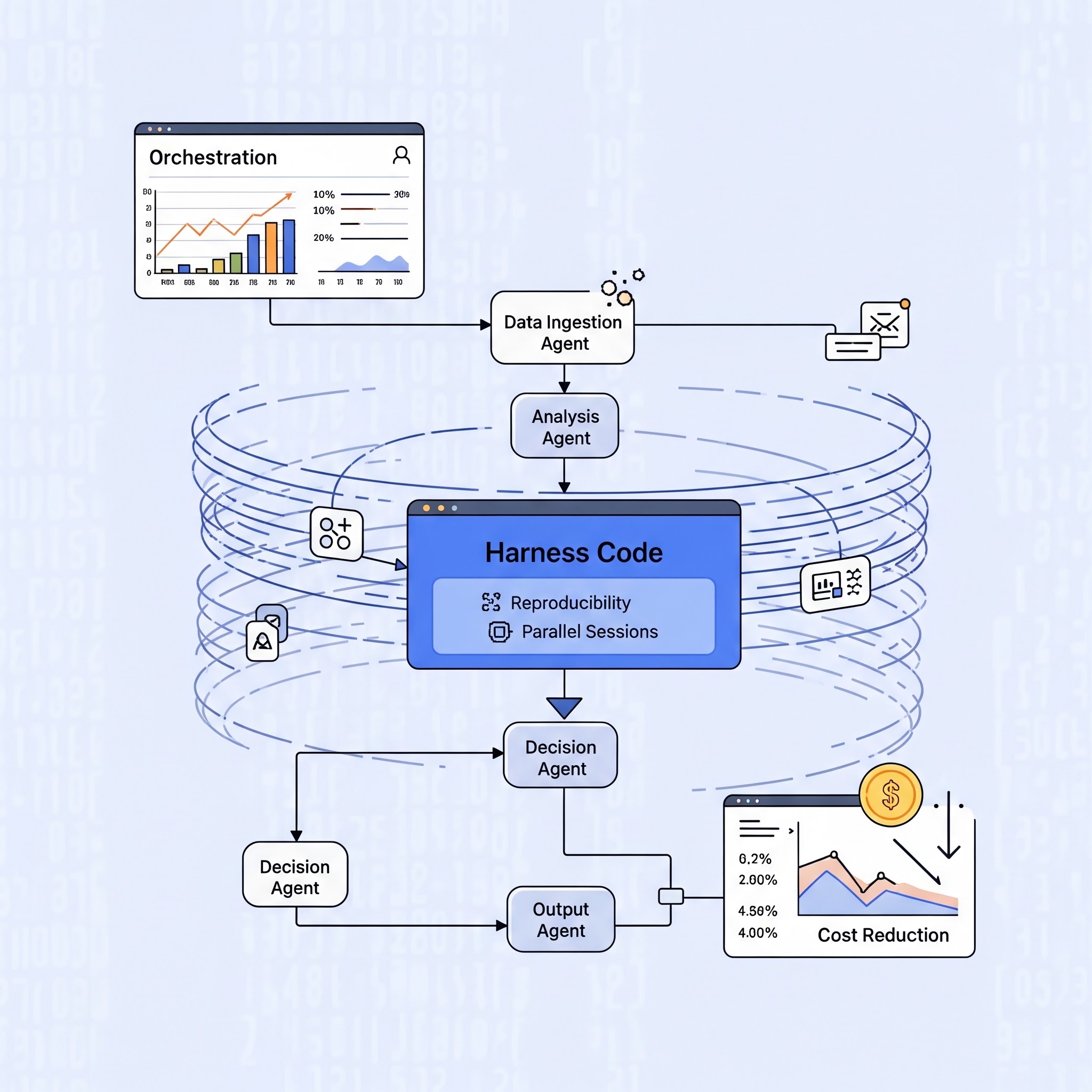
The era of merely writing code is evolving. As industry leaders like Andrej Karpathy and DHH suggest, we are now entering the “decade of agents”. This transformation shifts the developer’s focus from active coding to managing and reviewing the work of AI agents. To fully realize the potential of these digital interns, a robust foundation is required, centering on multi-agent workflows, intelligent orchestration, and highly reproducible development environments.
The Foundation: Why a Code Harness is Critical
To enable true parallel processing and reliable execution, a multi-agent system requires a dedicated “code harness”. This harness, typically implemented as a devcontainer, is essential for replicating the working environment.
The challenge with traditional environments is the lengthy setup process—cloning, configuring, installing dependencies, and resolving conflicts—which often leads to the infamous “works on my machine” problem. A good code harness solves this by providing a functional development environment in minutes, requiring only Git and Docker.
Crucially, this system prevents conflicts like “shared state,” where multiple agents attempt to modify the same directory and revert each other’s changes, leading to wasted time and high token consumption.
| Development Container | Deployment Container |
|---|---|
| Purpose: Functional for development and testing. | Purpose: Essential services for production. |
| Composition: Functional distro (Debian/Ubuntu), toolchain, compilers, debugging tools, optimized for running tests, includes fake data (seeds). | Composition: Minimal distro (Alpine/Slim), strict security, monitoring tools, consolidated layers for faster and compact builds. |
Orchestrating Intelligence with the OMOA Framework
The transition to multi-agent systems involves defining multiple sessions for different domains and managing agent interaction. For orchestration and experimentation, the Oh My Open Agent (OMOA) framework is preferred, using a mythology-themed set of specialized agents:
- Prometheus (Planning): The planning agent. It analyzes the task and generates a plan, deciding which agents to use and whether the work should be sequential or parallel, resolving parallelism conflicts before execution.
- Atlas (Execution): The final orchestrator responsible only for executing the plan generated by Prometheus.
- Sisifus (Primary Agent): The main agent that offers modes like the Ultra Work Loop, a multi-agent mechanism for iterative solutions necessary for tasks that won’t be achieved in a single pass (like investigating a failure or forcing a solution).
A critical component of this architecture is the need for built-in validation mechanisms. Unit tests are often insufficient for complex behaviors, necessitating an explicit validation agent within the multi-agent loop to confirm the correctness of the work.
AI Strategy and Cost Optimization.
Adopting multi-agent systems requires a strategic approach to cost management.
A top priority is token cost reduction. This is achieved by using simpler and faster models (like Sonnet or Haiku) for tasks that don’t require high intelligence, such as exploration or task delegation, which can lead to significant cost savings. The estimated budget for efficient, simultaneous multi-agent work is approximately $100 per month.
Before expanding general token access across the organization, the focus is on improving the Code Harness to ensure that the investment generates greater revenue and speed.